



On the morning of 8 July 2026, the Faculty of Law held the summer workshop titled Applications of Artificial Intelligence in Legal Education for teaching staff.
Proactively responding to the trend of deep integration between artificial intelligence and higher education, the workshop aims to deepen teaching reform for legal programs, develop innovative smart legal education models, and comprehensively enhance faculty’s digital teaching literacy and classroom innovation capabilities. Multiple faculty members took part in the training session, engaging in immersive learning and experience-sharing discussions centering on practical approaches for empowering legal teaching with AI technologies.
The Faculty also invited Professor Hong Huaqing from the Information Technology Development Office to join the session online, to hear teachers’ feedback and suggestions on the smart teaching platform.
Hosted in the University’s smart classroom, the workshop introduced the University’s smart teaching platform. The platform is designed to diversify teaching scenarios, improve learning experiences, teaching outcomes and work efficiency, and enable personalized, blended and collaborative learning.
Assistant Professor Wang Jia noted that instructors need patience and hands-on experience to operate multiple systems including Moodle, ClassIn and LAMS. Given that legal studies place strong emphasis on argumentation and logical expression, teachers should priorities the design of pre-class learning materials and test banks. This can boost students’ learning motivation while offering greater room for independent expression.
Drawing on his own teaching practice, Assistant Professor Liao Si demonstrated platform operations covering intelligent lesson preparation, in-class smart interaction and post-class student feedback.He shared various platform functions and practical skills, allowing participants to gain first-hand insights into new lesson-preparation workflows and diversified classroom formats enabled by the smart platform.
During open discussions, participants exchanged views freely. Combining the characteristics of legal disciplines and legal talent cultivation, they shared the impacts and challenges brought by pedagogical transformation in the AI era, openly put forward optimization proposals, learned from each other’s teaching practices, and sorted out tailored smart teaching solutions for different legal courses.
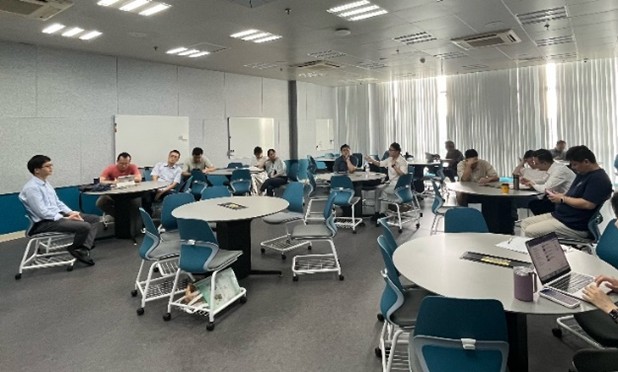
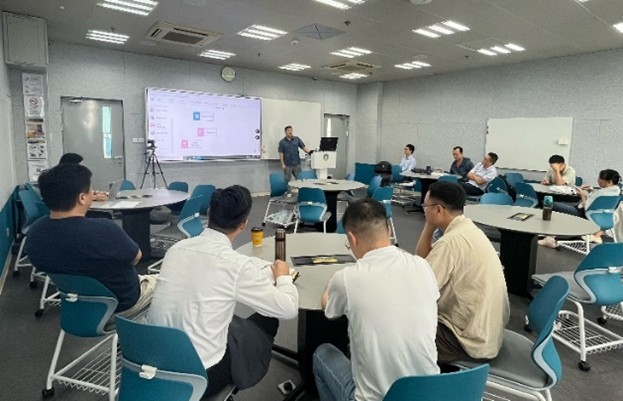
The workshop offered hands-on practice with the smart teaching platform, broadening innovative ideas for digital and intelligent legal teaching and laying a solid foundation for future smart classroom implementation and pedagogical innovation.Building on its strengths in legal education, the Faculty will continue to explore pathways to integrate artificial intelligence into legal education. It encourages teaching staff to embrace new digital education technologies, incorporate intelligent teaching tools into curriculum design, and drive high-quality development of legal education empowered by digitalization.

