


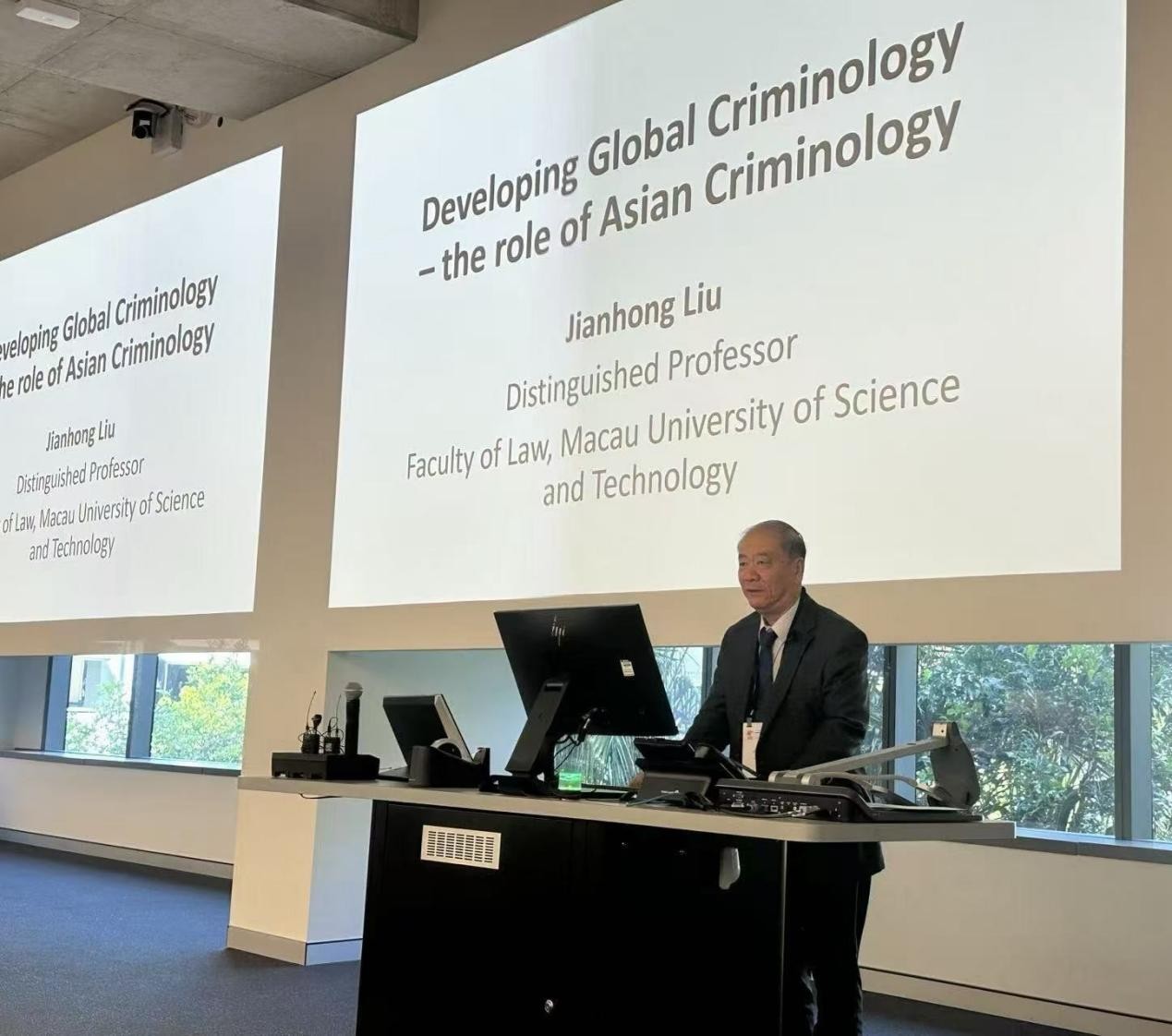
From December 3 to 5, 2025, the 16th Annual Conference of the Asian Criminological Society (ACS) was held at Queensland University of Technology (QUT) in Brisbane, Australia. Under the theme “Translational and Transnational Justice,” the conference brought together criminology and criminal justice scholars, practitioners, and researchers from around the world to exchange insights on major issues such as transnational crime, cybercrime, illicit markets, and evidence-based policy. As the largest and most internationally oriented criminology conference originating outside the Western world, the ACS annual meeting has become a significant platform connecting Asian criminology with the global academic community. Professor Jianhong Liu, Distinguished Professor of the Faculty of Law at Macau University of Science and Technology (MUST), was invited by the organizing committee as one of the keynote speakers and delivered a keynote speech titled “Developing Global Criminology – the Role of Asian Criminology.”
In his address, Professor Liu began by tracing the historical development of criminology as a discipline, noting that mainstream criminological theories and criminal justice models—often regarded as “universal”—are deeply rooted in Western social structures and cultural contexts. When transplanted directly into Asian societies, these models frequently fail to align with local social realities. Using the tension between “generality and particularity” as a conceptual entry point, Professor Liu emphasized the need to incorporate cultural characteristics and relational patterns of different societies into theoretical frameworks while maintaining the scientific criteria of generality and testability. Drawing on his own Relationism Theory of Criminal Justice, he demonstrated how concepts such as relationism and individualism can better explain conflict resolution and justice practices in Asian societies, thereby contributing essential theoretical perspectives to the development of global criminology. His lecture was well received and generated lively discussion among conference participants.
Hosted by Queensland University of Technology, this year’s conference was conducted primarily in English and featured keynote speeches, plenary sessions, parallel panels, conference dinners, and visits to criminal justice institutions. The program showcased cutting-edge scholarship in crime and social control and highlighted the interdisciplinary and international nature of the event. In addition to Professor Liu, keynote speakers Professor David Weisburd, laureate of the Stockholm Prize in Criminology, (known as “Nobel prize in criminology), Dr. Bitna Kim—former President of the Academy of Criminal Justice Sciences (ACJS) and current Vice Chair of the Division of International Criminology of the American Society of Criminology (ASC), Dr. Cassandra Cross of QUT, and Professor Marleen Easton of Ghent University. Their participation underscored the global stature of the ACS annual meeting and its role as a major forum for criminological scholarship beyond the Western world.
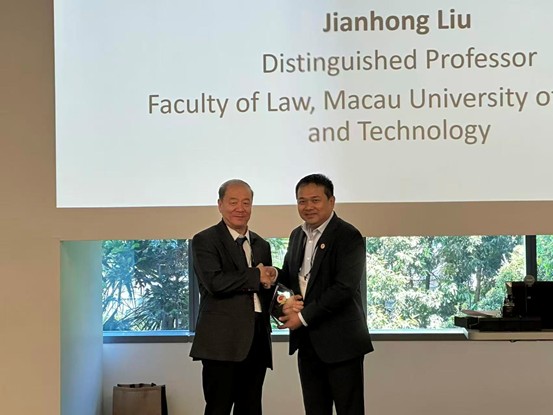
During the Brisbane conference, Professor Liu was also awarded the Asian Criminological Society Distinguished Book Award 2025 and Distinguished Service to Asian Criminology Society, recognizing the international impact of his recent English-language monograph on crime and criminal justice in Asia. This honor further affirms his academic leadership in Asian criminology and his significant scholarly contributions to the field. Professor Liu had previously received several major international awards, including the Sellin & Glueck Award and the Freda Adler Distinguished Scholar Award from the American Society of Criminology (ASC), the G.O.W. Mueller Award for Distinguished Scholar from the International Section of the Academy of Criminal Justice Sciences (ACJS), the ACS Distinguished Book Award, and the Best Scholarly Publication Award from the Association of Chinese Professors of Social Sciences in the United States (ACPSS).